
Schema Therapy
At Affirm Psychology, we draw from a variety of evidence-based treatment approaches, including Cognitive Behavioural Therapy (CBT), Dialectical Behaviour Therapy (DBT), and Acceptance and Commitment Therapy (ACT). However, Schema Therapy (ST) is our primary therapeutic modality. Schema Therapy often incorporates skills and techniques from these other approaches, allowing us to provide an individualized and comprehensive therapy experience. Below is an overview of Schema Therapy to help you understand how it works and what to expect.
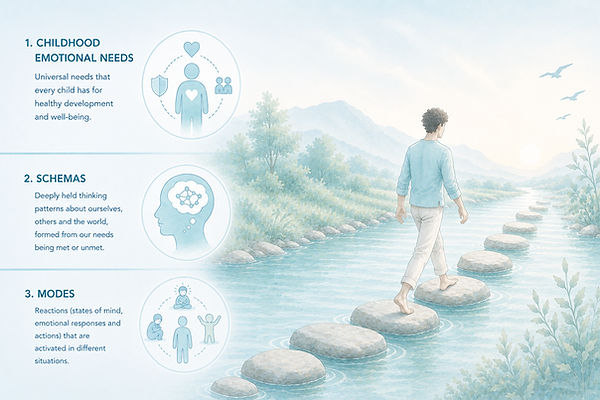
What is Schema Therapy?
Schema Therapy is a structured and supportive approach to psychological treatment, designed to help you understand and change patterns that may be causing distress in your life. These patterns, called "schemas," are deeply held beliefs and feelings about yourself and others, often developed during childhood and adolescence. Schema Therapy can help you explore where these patterns come from and how they affect your current emotions, relationships, and decision making.
Understanding Schemas, Childhood Emotional Needs and Modes
Schemas are shaped by early life experiences, especially when important emotional needs such as feeling safe, loved, valued, or understood were not fully met. When these needs are unmet, we may develop certain beliefs or coping strategies to manage difficult feelings. Over time, these 'maladaptive' schemas become automatic and lead to challenges in adulthood, such as low self-esteem, difficulty trusting others, or feeling disconnected. Because schemas operate automatically, you may not be consciously aware that you have them, and responding based on these patterns often happens without realising it.
In Schema Therapy, we also talk about "modes." Modes are the emotional states or parts of yourself that you shift into, often in response to certain situations. For example, you might notice a part of yourself that feels vulnerable, another that criticises you, or one that tries to avoid painful feelings. Understanding your modes helps you see how you react to schemas and how you can respond in healthier ways.
Let's consider this with an example of a very common schema called Unrelenting Standards. The Unrelenting Standards schema develops when emotional needs for acceptance, reassurance, or unconditional love were not fully met during childhood. If a child grows up feeling that they must always achieve, perform perfectly, or meet high expectations to be valued, they may internalise the belief that anything less than perfection is unacceptable. As adults, this schema can operate automatically, leading to modes that look like persistent self-criticism, difficulty relaxing, and a sense that mistakes are not allowed. You may find yourself driven to work excessively hard, set unrealistic goals, or feel anxious about not meeting your own standards. Understanding these connections can help you recognise when the schema is active, identify your emotional needs, and develop healthier ways to respond.
Schema therapy focuses on maladaptive schemas and modes, as these are the ones what cause you distress and often bring people into therapy. But you also have adaptive (or healthy) schemas and modes which will be identified and strengthened in sessions.
What to expect with Schema Therapy
Schema Therapy combines elements from several therapeutic approaches and is tailored to your individual needs. Together with your psychologist, you will:
-
Identify your schemas and modes, and understand their origins
-
Explore how these patterns affect your thoughts, feelings, and behaviours
-
Learn practical strategies to challenge and change unhelpful patterns
-
Develop new ways to meet your emotional needs and improve your relationships
Schema Therapy is a collaborative process where you and your psychologist work together in a safe and caring environment. You will be supported as you gain insight, build new skills, and make positive changes in your life. The pace and techniques are adapted to what feels comfortable for you.
Where did Schema Therapy come from?
Schema Therapy was developed in the early 1990s by Dr. Jeffrey Young, a clinical psychologist. It originated as an expansion of traditional Cognitive Behavioural Therapy (CBT), specifically to address longstanding and complex psychological difficulties that were not fully resolved by CBT alone. Dr. Young integrated concepts and techniques from attachment theory, psychodynamic therapy, and experiential approaches to create Schema Therapy.
The model was designed to help individuals understand and change deep-rooted patterns called schemas that often begin in childhood and persist into adulthood. Schema Therapy has since been supported by research and is widely used for a range of concerns, including personality disorders, complex and relational trauma, chronic depression, anxiety, and relationship difficulties.
What is Forensic Schema Therapy?
Forensic Schema Therapy is a specialised adaptation of Schema Therapy designed for individuals within forensic settings, such as prisons or with the probation and parole system. It addresses the complex psychological patterns and early maladaptive schemas that may contribute to offending behaviour, aggression, or difficulties with impulse control.
This approach integrates traditional Schema Therapy methods with additional strategies to manage risk, promote rehabilitation, and support positive behavioural change. Forensic Schema Therapy focuses on understanding the links between childhood experiences, unmet emotional needs, and the development of schemas and modes that influence criminal behaviour. The therapy aims to help individuals develop healthier coping strategies, improve emotional regulation, and reduce the likelihood of reoffending.
What are the Maladaptive Schemas?
Over time, schema therapy has evolved and broadened, but here is a brief description of the original 18 maladaptive schemas identified by Young:
-
Abandonment/Instability - Belief that significant others will not be able to provide reliable support or will leave.
-
Mistrust/Abuse - Expectation that others will hurt, abuse, or take advantage of you.
-
Emotional Deprivation - Believing that your emotional needs for support, affection, or empathy will not be met by others.
-
Defectiveness/Shame - Belief that you are flawed, unworthy, or undeserving of love.
-
Social Isolation/Alienation - Feeling isolated, different, or not belonging to groups or communities.
-
Dependence/Incompetence - Belief that you are unable to handle daily responsibilities without help from others.
-
Vulnerability to Harm or Illness - Exaggerated fear that disaster, illness, or catastrophe could occur at any time.
-
Enmeshment/Undeveloped Self - Difficulty establishing a sense of identity or independence due to over-involvement with others.
-
Failure - Belief that you have and will fail at important things or are inadequate compared to others.
-
Entitlement/Grandiosity - Belief that you are superior to others and entitled to special treatment or privileges.
-
Insufficient Self-Control/Self-Discipline - Difficulty exercising sufficient self control and frustration tolerance to achieve personal goals
-
Subjugation - Excessive surrendering of control to others, often to avoid conflict or rejection.
-
Sacrifice - Putting others' needs ahead of your own to the point of neglecting your own needs.
-
Approval-Seeking/Recognition-Seeking - Overemphasis on gaining approval, recognition, or attention from others.
-
Negativity/Pessimism - Pervasive focus and worry on negative aspects of life while minimizing positive possibilities or outcomes.
-
Unrelenting Standards - Belief that you must meet high standards of performance or perfection to avoid criticism from yourself or others.
-
Punitiveness - Belief that people should be harshly punished for mistakes, including yourself.
-
Emotional Inhibition - Suppression of spontaneous action, emotions or communication to avoid disapproval, shame or losing control